That empty corner isn’t necessarily wasted space. It might just be doing the wrong job. Before you squeeze in another piece of furniture, decide what your room actually needs most: a place to work, more storage, or a little of both.
First, Decide What the Corner Needs to Do
A small corner can solve a surprisingly big problem, but only if you give it one first. Look around the room before you shop. Are you short on workspace? Is clutter piling up because you don’t have enough storage? Or does the corner need to handle both?
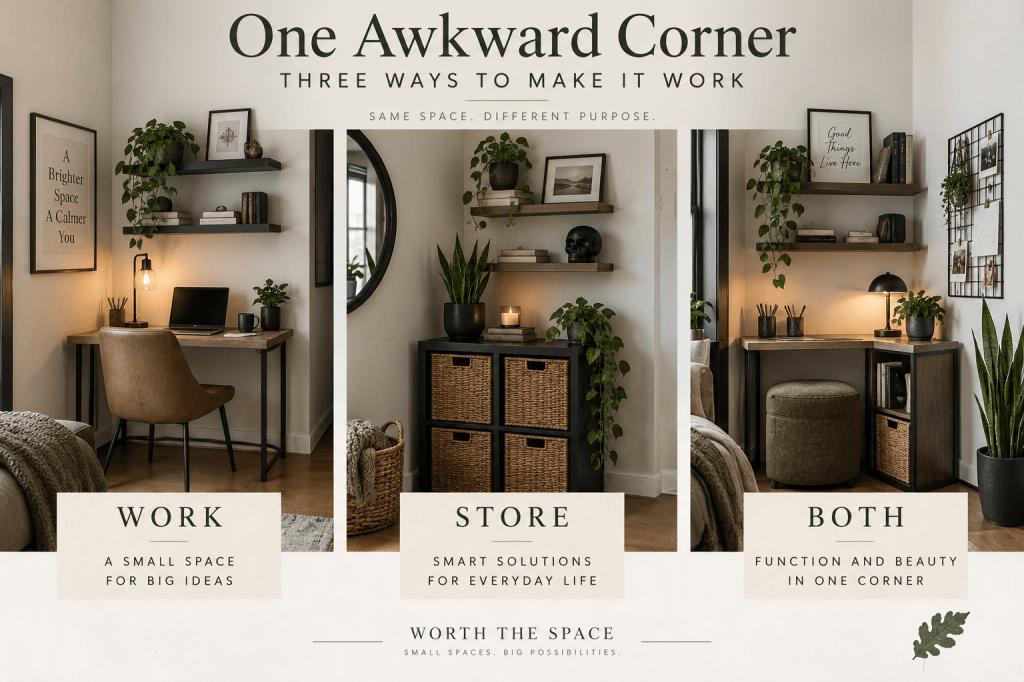
1. WORK: Turn the Corner Into a Compact Workspace
If you’re short on workspace, don’t automatically look for the smallest desk you can find. The better goal is a desk that’s only as deep and wide as your actual work requires. A laptop needs far less room than a monitor, keyboard and paperwork, so start with what you use every day and work backward from there.
THE WORTH THE SPACE RULE
Don’t buy furniture to fit the corner. Choose furniture that fits the job, then make sure it fits the corner.
2. STORE: Use the Corner to Get Things Off the Floor
When storage is the real problem, think up before you think out. A tall, narrow cabinet, floating shelves or stacked storage can use the height of the room without stealing much floor space. The goal isn’t to fill every inch of wall. It’s to give the things already cluttering the room somewhere intentional to live.
3. BOTH: Make One Corner Do Two Jobs
Sometimes the corner can’t afford to have just one job. A shallow desk paired with shelves above it, a compact workstation beside a narrow storage unit, or a desk with useful built-in storage can give you both function and organization without creating a wall of furniture.
The trick is to keep one function visually dominant. If it’s primarily a workspace, let the desk be the focus and move storage upward or beside it. If storage matters more, keep the work surface simple and compact. Trying to make every inch do everything usually makes a small space feel busier, not better.
Before You Buy Anything, Measure These 4 Things
- Corner width: Measure the usable wall space, not just the wall itself. Account for doors, baseboards, vents and outlets.
- Furniture depth: Mark the depth on the floor with painter’s tape so you can see how far the piece will actually stick into the room.
- Clearance: Make sure drawers, doors and desk chairs have enough room to open and move comfortably.
- Vertical space: Look above the furniture. Shelves and wall-mounted storage can add function without increasing the footprint.
The Best Corner Is the One That Solves a Problem
An awkward corner doesn’t need to become a perfectly styled Pinterest moment. It just needs to make the room work better. Start with the problem you actually need to solve, choose the smallest solution that solves it well, and leave a little breathing room.
Because in a small space, everything should earn its place.


Leave a Reply