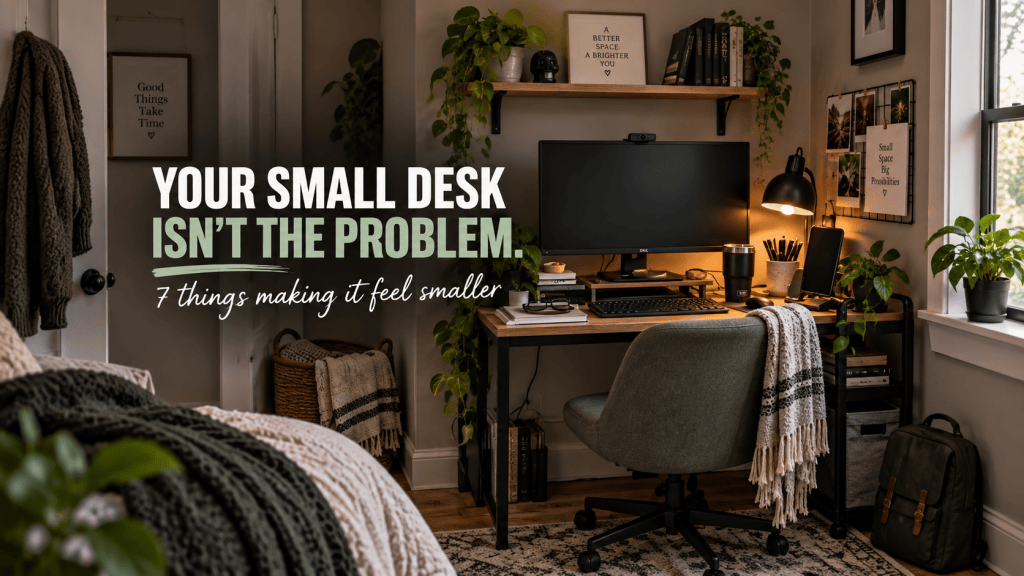
A small desk isn’t automatically a bad workspace.
The problem is that every object you put on it competes for the same limited surface area. A monitor stand that’s deeper than it needs to be, a pile of notebooks you rarely open, an oversized lamp or a collection of things that simply don’t have another home can make a perfectly usable desk feel frustratingly small.
Before you start shopping for a bigger desk, look at what’s happening on the one you already have.
You might not need more space.
1. Your Monitor Is Taking Up More Desk Than It Needs To
A monitor doesn’t just take up the space occupied by the screen. Its stand can claim a surprisingly large chunk of your desk, especially if it has a wide or deep base.
On a small desk, that matters.
Take a look at the space underneath and around your monitor. If the stand prevents you from using that area for your keyboard, notebook or other everyday items, your monitor may be using more of your workspace than you realize.
A smaller monitor stand or riser can sometimes help. In the right setup, a monitor arm can free up even more surface area by moving most of the support off the desk entirely.
But don’t buy anything yet.
First, ask yourself:
If the monitor stand disappeared, would I actually use the space underneath it?
If the answer is yes, you’ve found some desk space worth reclaiming.
THE WORTH THE SPACE RULE
On a small desk, don’t just measure what something does. Measure how much space it takes to do it.
2. Too Many Things Have Earned a Permanent Spot
Small desks get crowded when temporary things become permanent residents. 😂
The notebook you used yesterday stays beside the keyboard. Your headphones live on the corner. Three pens become twelve. A water bottle, coffee mug, hand cream and charging cable slowly claim whatever space is left.
None of those things seems like a problem on its own.
Together, they can take away a surprising amount of usable workspace.
Look at everything currently sitting on your desk and ask one simple question:
Do I need this within reach every single day?
If not, it doesn’t necessarily need to disappear. It just needs another home nearby.
A drawer, shelf, wall organizer or small storage unit beside the desk can keep occasional-use items accessible without making them permanent fixtures on your work surface.
The goal isn’t an empty desk.
It’s a desk where the things taking up space are the things actually helping you use it.
3. Your Desk Might Be Deeper Than Your Work Requires
When space is limited, we tend to focus on a desk’s width. But depth can have an even bigger effect on how the room feels.
A deep desk pushes your chair farther into the room and takes away floor space that could otherwise become walking clearance, storage or simply breathing room.
That doesn’t mean shallow is always better.
Someone working primarily from a laptop may be perfectly comfortable with a relatively shallow surface. A setup with a large monitor, keyboard and paperwork may genuinely need more depth.
The question isn’t:
“What’s the smallest desk I can fit?”
It’s:
“How much desk depth does my actual setup require?”
Before replacing anything, notice how much of the back portion of your desk you genuinely use. If several inches are permanently empty or simply collecting things because the space exists, your desk may be occupying more of the room than your work actually requires.
And if your desk sits in a bedroom or another shared space, those few inches can matter more than you’d expect.
A desk should be deep enough to work comfortably, but it doesn’t get bonus points for taking up floor space you never use. 😂
4. Your Storage Is Spreading Sideways
When a small workspace needs more storage, the instinct is often to add something beside the desk.
A filing cabinet. A rolling cart. A drawer unit. A basket. Then perhaps another little organizer because apparently the first organizer needed emotional support. 😂
Before long, a four-foot workspace has quietly become a seven-foot workspace.
When floor space is limited, look up before you look out.
Floating shelves, wall-mounted organizers, pegboards or even one well-placed shelf above the desk can sometimes hold things that would otherwise require another piece of furniture.
That doesn’t mean covering every inch of wall with storage. Too much vertical storage can make a small workspace feel visually crowded too. Instead, start with what you’re trying to store and give it the smallest useful home.
If you only need somewhere for a few notebooks and office supplies, you probably don’t need an entire cabinet beside your desk.
Every piece of storage should solve a storage problem, not create a new space problem.
5. Your Chair Needs More Space Than You Think
The desk isn’t the only part of a workspace with a footprint.
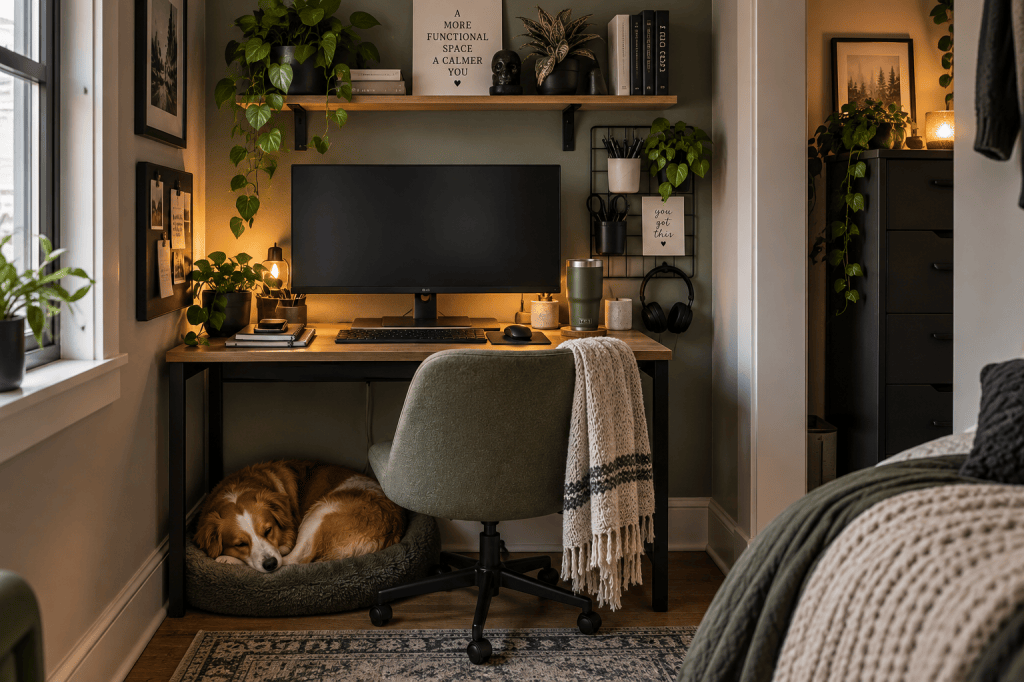
Your chair needs somewhere to go when you’re sitting, somewhere to move when you stand up, and enough clearance that using your desk doesn’t turn into a daily furniture obstacle course. 😂
This becomes especially important when a workspace is squeezed into a bedroom, living room or narrow corner.
A desk may technically fit against a wall, but if pulling the chair out blocks a doorway, bumps into the bed or takes over the main walking path, the workspace itself is effectively much larger than the desk.
Before deciding that your room can’t handle a desk, look at the entire working footprint:
Desk + chair + the space required to actually use both.
Sometimes moving the desk a few inches, changing its orientation or choosing a chair that tucks farther underneath can improve the room more than replacing the desk itself.
And don’t sacrifice comfort just to save a few inches. A chair you hate sitting in hasn’t earned its space either. 😏
The best small-space layout isn’t the one that fits the most furniture. It’s the one you can actually move through and use comfortably.
6. Visual Clutter Is Making the Desk Feel Smaller
Sometimes your desk has enough physical space, but it still feels crowded.
That can happen when there are too many things competing for your attention at once: cables crossing the surface, stacks of papers, several small organizers, decorations, sticky notes, chargers and miscellaneous objects all living within the same little area.
You don’t need to turn your workspace into a sterile showroom to fix it. Instead, try grouping related things together and reducing the number of separate objects your eye has to process.
Five loose pens can become one cup. Several charging cables can follow one route. Papers can become one stack or tray. A collection of small decorations might become one or two things you genuinely enjoy looking at.
You’re not necessarily removing everything.
You’re creating visual breathing room.
And this is where small-space advice sometimes gets annoying:
“Just get rid of all your stuff!”
No. 😂
Your workspace is allowed to have personality. Photos, plants, ridiculous little objects that make you happy, and apparently the occasional disgruntled Brussels Griffon all have a place.
The question is simply whether everything needs to be visible at the same time.
A small desk doesn’t have to look empty to feel spacious. It just needs enough quiet space for your eyes and your work to land.
7. Your Desk Has Become Storage Instead of Workspace
This one happens slowly.
A desk starts as a place to work. Then a package gets dropped on one corner. Mail lands beside it. Something needs to be put away “later.” A shopping bag appears underneath.
Eventually, part of the desk isn’t really a workspace anymore.
It’s a holding zone for things that haven’t found their actual home. 😂
And on a small desk, losing even one corner matters.
Look for anything sitting on or around your desk that has nothing to do with working there. Instead of simply moving the pile somewhere else, ask why it keeps ending up at the desk in the first place.
Maybe mail needs a permanent landing spot near the door. Maybe paperwork needs one tray. Maybe returns need a basket somewhere else. Maybe miscellaneous household items need five minutes of actual decision-making instead of six weeks of desk residency. 😬
The goal isn’t to become perfectly organized.
It’s to protect your workspace from quietly becoming overflow storage for the rest of the room.
If something repeatedly lands on your desk, that’s usually a clue that it needs a better home somewhere else.
Your desk doesn’t need to hold everything you haven’t dealt with yet. It needs to leave enough room for the thing you came there to do.
Before You Buy a Bigger Desk, Try This
Before you decide your desk is simply too small, clear everything off it that isn’t essential and start again.
Put back only what you genuinely need to work: your computer, monitor, keyboard, mouse or whatever your everyday setup requires.
Then add the other things deliberately.
Which items need to stay within reach? Which could live on a shelf or in a drawer? Is your monitor stand using valuable surface area? Is your storage spreading into the room? Does your chair have enough clearance? Is part of the desk functioning as household storage instead of workspace?
Then use the setup for a few days.
You may discover that your desk really is too small for what you need. And if that’s the case, replacing it might be the right decision.
But you’ll be shopping with a much better understanding of what the new desk actually needs to do.
A Small Desk Should Still Work for You
Small-space living isn’t about squeezing yourself into the tiniest furniture possible.
It’s about being deliberate with the space you have.
Your desk should be large enough to support the way you actually work, without taking more of the room than it needs. The things around it should make the workspace more functional, not slowly consume it.
So before you measure your wall for a bigger desk, take another look at the one you already have.
The problem might not be how much space your desk gives you.
It might be how much of that space you’ve accidentally given away.


Leave a Reply