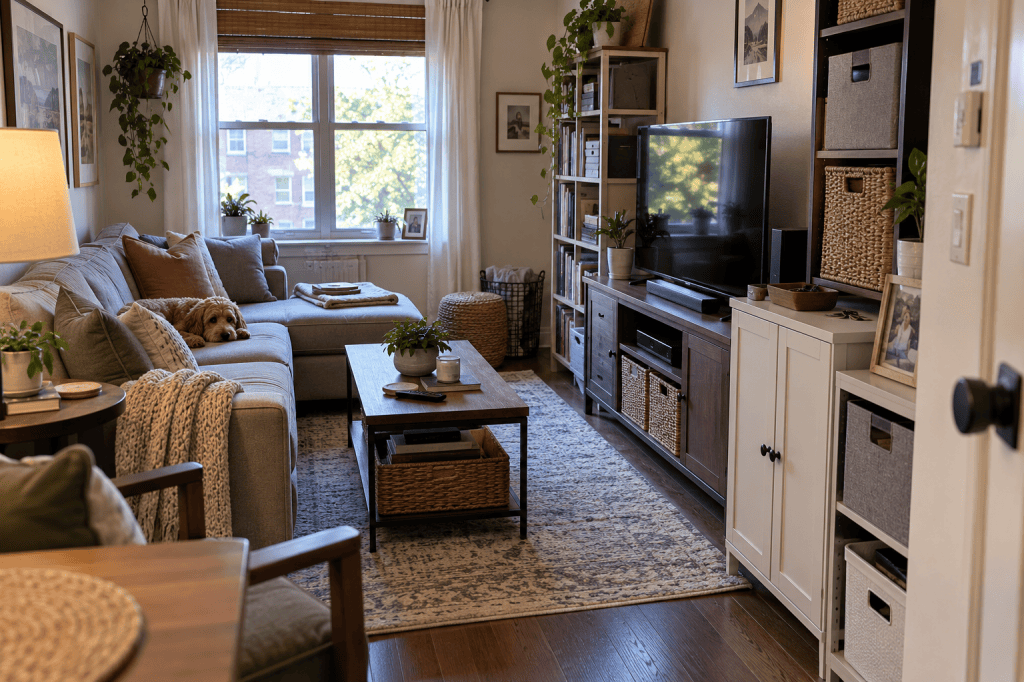
You buy a basket because the room feels cluttered.
The basket needs somewhere to live, so you clear a spot for it. A few loose things go inside. Excellent. Progress.
Except now you own exactly the same amount of stuff, plus a basket.
Sometimes that’s still an improvement. Good storage makes a small home easier to use.
But storage isn’t automatically space-saving simply because it has the word “storage” in the product description.
It takes up space too.
And that’s worth thinking about before another cabinet, cart, shelf or suspiciously charming set of matching bins moves in.
Why an organized small space can still feel crowded
There are at least two different problems hiding inside the sentence, “I need more storage.”
One is a genuine capacity problem. You have normal belongings you use and want to keep, and your home doesn’t provide enough sensible places to put them.
The other is a space-allocation problem.
Things have homes, but those homes don’t work particularly well.
A large cabinet holds surprisingly little. Prime closet space contains things used twice a year. Everyday items live somewhere inconvenient, so they never quite make it back. Several half-empty baskets occupy an entire shelf. A piece of storage furniture solves one problem while narrowing the walkway around it.
Everything might technically be organized.
The room can still feel full.
So before looking for another small-space storage idea, diagnose which problem you’re trying to solve.
Because a capacity problem and a poor-storage problem don’t necessarily need the same answer.
First, figure out what’s making the space feel full
Choose one problem area rather than attempting to reorganize your entire home in a burst of Sunday afternoon ambition.
Then look at what is physically consuming the space.
Not what looks untidy. What is using the space?
It might be belongings without homes.
It might be storage itself.
It might be furniture that’s too large for what it accomplishes.
It might be frequently used things stored too far away, causing them to collect on easier surfaces.
It might be several containers doing a job that one container could handle.
Or the room might genuinely contain more belongings than its available storage can comfortably support.
Those are different problems.
Try removing the containers from your thinking for a moment and look at the belongings themselves.
- What is used here?
- What needs to stay here?
- What could live somewhere else?
- What is taking up prime storage despite being rarely used?
- What keeps landing on counters, tables, chairs or the floor even though it supposedly has a home?
That last question is particularly useful.
If something repeatedly refuses to stay organized, the problem isn’t necessarily the person using it. Its assigned home might simply be inconvenient.
A beautifully labelled container on the top shelf of a closet is not especially useful for something you reach for six times a day.
Give the easiest storage to the things you use most
Small homes don’t have equal-value storage.
A drawer you can open with one hand while standing in the kitchen is more useful than a box behind three other boxes in a closet.
Both provide storage capacity. They do not provide the same access.
Think of your home’s storage in rough layers.
- Things you use constantly: Give them the easiest locations.
- Things you use regularly: Keep them convenient, although they don’t need the absolute best spots.
- Things you use occasionally: They can tolerate less convenient storage.
- Things you rarely use: They should have to justify occupying your most useful storage space at all.
This doesn’t mean getting rid of everything you don’t use every week.
Holiday decorations are allowed to exist. So are sentimental belongings, camping equipment, extra bedding and the enormous roasting pan that emerges twice a year and apparently requires its own postal code.
It means matching access to frequency.
If seasonal items occupy the easiest closet shelf while everyday belongings pile up outside the closet, buying another organizer might not be your first move.
Reassign the storage you already have.
Before buying anything, try the Storage Footprint Test
Worth the Space has a simple rule: if something takes up limited space, it should earn its place.
Storage doesn’t get an exemption.
Before bringing another storage product into a small home, put it through the Storage Footprint Test.
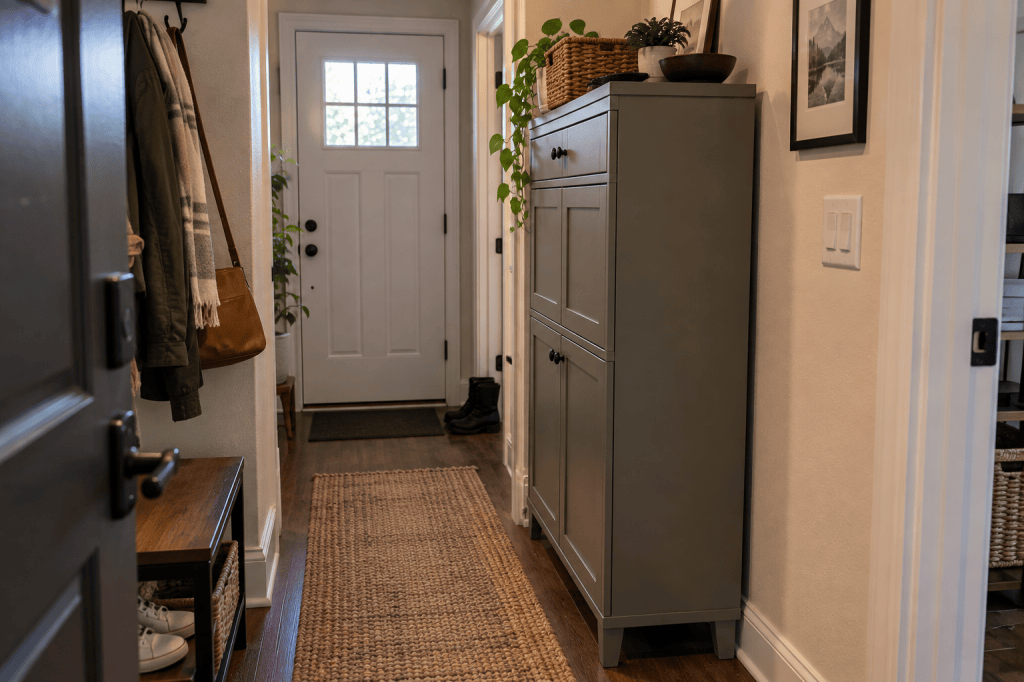
1. What space will it take?
Look beyond the object’s dimensions.
Will it consume floor space? Wall space? A useful surface? The back of a door? Space underneath a bed?
Will drawers need clearance to open? Will you need room to stand in front of it? Will it make an already narrow route through the room tighter?
A slim cabinet and a wall shelf both provide storage, but they make completely different demands on a room.
The relevant question isn’t simply, “Will it fit?”
It’s, “What useful space becomes unavailable once it’s here?”
2. What will it actually hold?
Start with the belongings, not the organizer.
A storage solution works better when its shape and capacity suit a specific problem.
Tall narrow shelving can make sense for items that work well on shelves. It is less impressive if everything you own is wide, bulky or needs to be hidden behind a door.
A shallow over-door organizer can make use of otherwise idle space, but it isn’t the answer to storing a vacuum cleaner.
Obvious when you say it like that.
Less obvious when you’re standing in the storage aisle admiring a product whose packaging promises it has finally defeated square footage.
Know what needs a home first.
Then find storage shaped for the job.
3. What useful space will it free?
This is the part that gets missed.
Adding storage is worthwhile when it gives useful space back somewhere else.
Imagine a narrow cabinet occupying a small section of an otherwise unused wall. If it allows you to remove several containers from the floor and clear a surface you use every day, that cabinet might earn its footprint easily.
Now imagine the same cabinet in a different room. It protrudes into the walkway and mostly stores things that were already contained elsewhere.
Same cabinet. Completely different value.
Ask what gets better after the storage arrives
If the answer is mostly, “I’ll have another place to put things,” keep investigating.
4. How easy will it be to use?
Storage has to work on an ordinary Tuesday, not only on the afternoon you organize it.
Can you get something out without removing three other things first?
Can everyone who uses the item reach it?
Can you put it away easily?
Does opening the storage require moving furniture?
Will you realistically return the item there?
This is why maximum capacity isn’t always the goal.
Packing every available inch can create impressive storage density and terrible usability.
Sometimes leaving a little breathing room inside a drawer, cabinet or closet makes the whole system easier to maintain.
5. Does it earn its footprint?
Now compare what the storage takes with what it gives back.
A useful storage solution should improve the function of the space overall.
That might mean recovering floor area, clearing an important surface, making everyday belongings easier to put away, consolidating several inefficient containers or using previously wasted space.
If the new organizer mostly gives you somewhere to store belongings while making the room more crowded, it hasn’t solved enough.
Before adding storage, make the storage you have work harder
This is the decidedly less exciting part because nobody gets to click “add to cart.”
It is also where some of the easiest improvements live.
Consolidate half-used storage
Look inside your existing baskets, bins, drawers and cabinets.
Storage tends to accumulate gradually. One basket arrives for one category. Another appears later. Eventually, the containers themselves become part of the space problem.
Two partially filled bins might become one.
Supplies spread across several locations might make more sense together.
An entire drawer devoted to a tiny category might be better reassigned.
The goal isn’t to cram everything as tightly as physically possible. It is to notice when the storage system has become larger than the belongings it serves.
Move rarely used things out of prime positions
Easy-access storage should work hard.
If the most convenient cabinet contains things you rarely touch while everyday belongings sit out because there’s “nowhere to put them,” try swapping their locations.
Less frequently used belongings can often tolerate higher shelves, under-bed storage or less convenient areas.
That doesn’t mean every empty wall needs shelves or everything should immediately migrate beneath the bed.
It means low-demand belongings are better candidates for less convenient storage than the things you use every day.
Look for empty space before adding another footprint
Some homes lack storage furniture but still contain usable storage territory.
- Above an existing cabinet.
- Behind a suitable door.
- Under a bed.
- On an unused section of wall.
- Inside furniture that already has underused capacity.
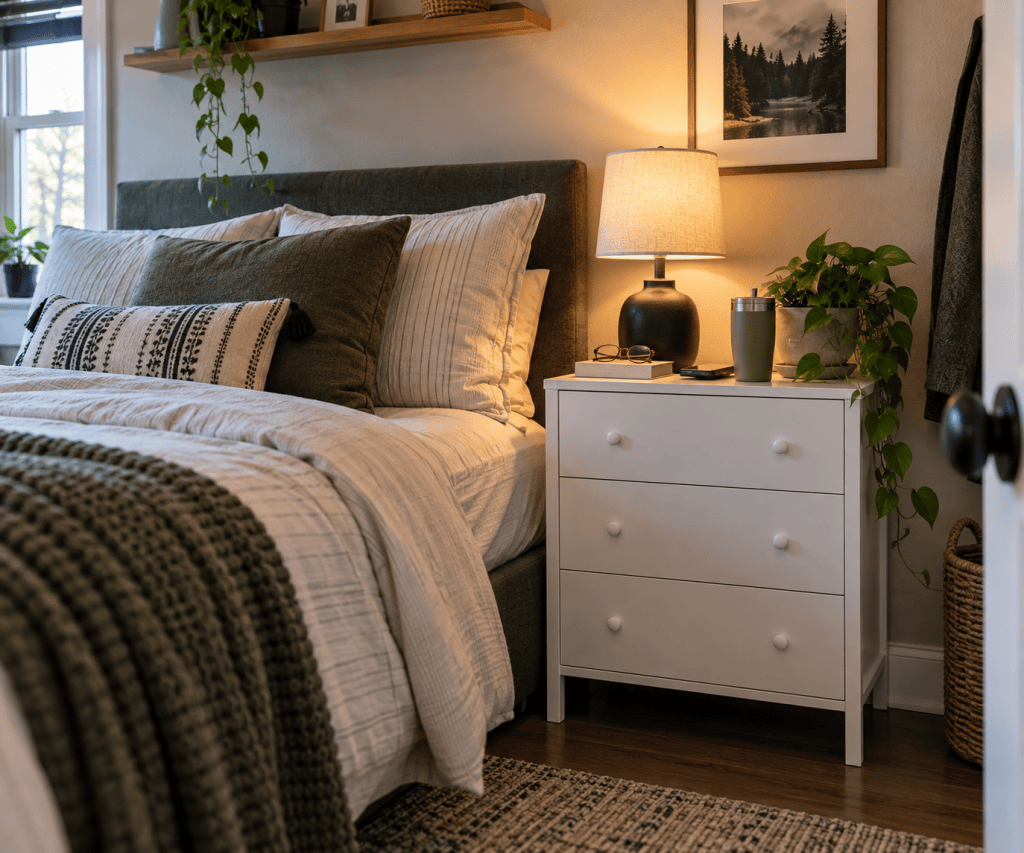
A taller storage piece can sometimes provide more capacity without spreading farther across the floor. Multifunctional furniture can also combine two necessary jobs within the same area.
But unused space isn’t automatically storage space.
Accessibility still matters.
Putting something in a clever location that makes you mutter every time you need it is not a triumph of organization.
Match awkward or hidden locations with things you don’t need constantly.
Sometimes the best storage decision is removing storage
This sounds backwards until you find a piece of furniture that takes up a heroic amount of floor space while storing twelve things badly.
Storage furniture should face the same scrutiny as every other object in a small home.
- How much does it hold?
- How useful is that capacity?
- Could the same belongings fit somewhere else?
- What would the room gain if the furniture disappeared?
A wide shelving unit filled mostly with decorative baskets might be less useful than one taller, narrower piece.
A second dresser might no longer earn its footprint after a wardrobe clear-out.
A freestanding cabinet might be occupying the only wall where a more useful piece of furniture could go.
You don’t need to remove storage simply to make a room look emptier.
Remove or replace it when the space it consumes is more valuable than the storage it provides.
That’s a different standard.
When buying more storage does make sense
Sometimes you run the numbers, shuffle the shelves, consolidate the bins and discover something unsurprising:
You genuinely need more storage.
Fine.
The goal was never to win a moral victory over baskets.
Now you know what problem the new storage needs to solve.
Go vertical when floor space is the constraint
If you have usable wall height but limited floor area, taller or wall-mounted storage can increase capacity without spreading farther across the floor.
This can work well for books, household supplies, collections and other belongings suited to shelving or contained vertical storage.
For renters, mounting restrictions matter. Freestanding tall storage or suitable removable systems might make more sense where permanent installation isn’t appropriate.
Tall furniture also needs to be used and secured appropriately for the particular product and household.
Use under-bed storage for the right belongings
A bed already occupies substantial floor space, which makes the area underneath worth considering.
Under-bed storage is particularly suited to things that need a home but don’t require constant access, provided the bed has appropriate clearance and the containers remain reasonably accessible.
That might include seasonal clothing, spare linens or other occasional-use belongings.
It becomes less useful when everything underneath turns into an archaeological dig.
If you can’t remember what’s there or have to dismantle half the bedroom to retrieve it, you’ve gained capacity at the expense of access.
Use doors and narrow gaps for small, appropriate categories
The back of a suitable door can hold shallow items without claiming another section of floor.
Likewise, a narrow gap might accommodate slim storage when the dimensions and access make sense.
These solutions work best when the belongings fit the storage naturally.
Don’t buy an elaborate over-door system and then go hunting around the house for things to fill it with.
We are trying to solve storage problems, not create internships for empty organizers.
Let furniture do two useful jobs when possible
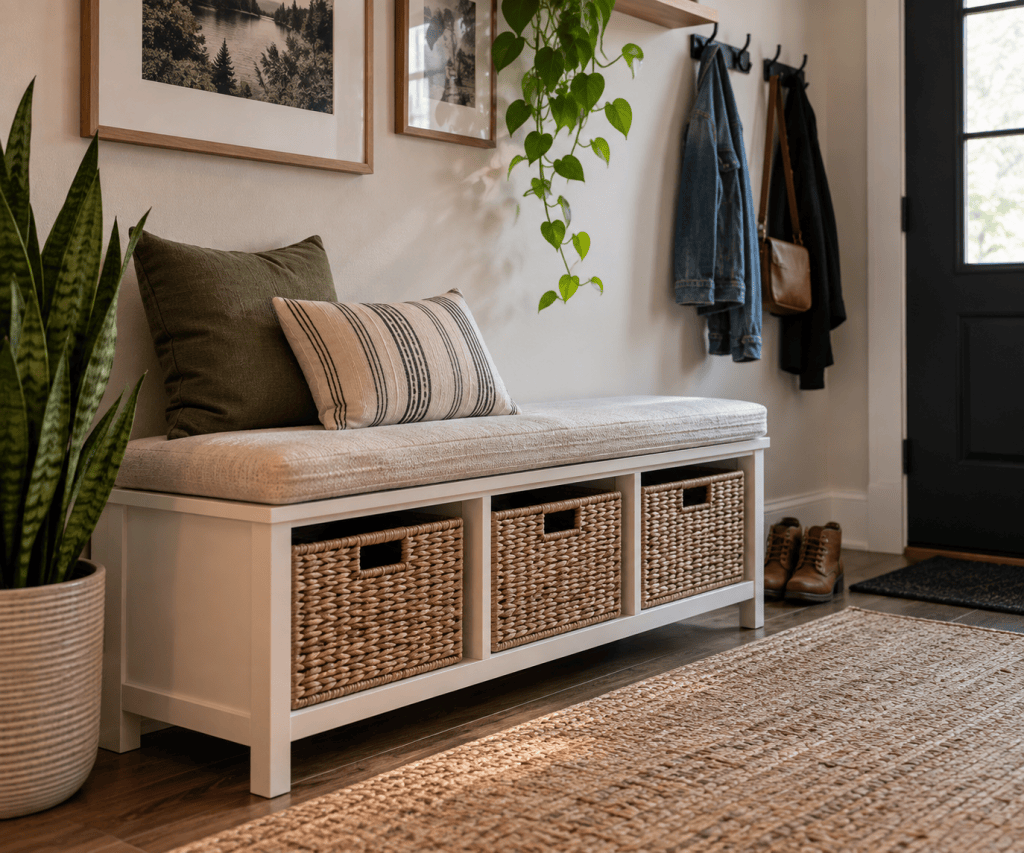
A storage bench, storage bed or other multifunctional piece can make sense when you already need the primary piece of furniture.
The important distinction is whether it replaces something.
A bench you need for seating that also stores blankets combines two useful functions.
Buying an additional bench solely because it contains storage is a different equation. Now it needs floor space of its own.
Multifunctional furniture earns its reputation in small spaces when multiple necessary functions genuinely share one footprint.
“Multifunctional” printed on a product listing doesn’t automatically make the furniture useful in your room.
The functions still have to be functions you need.
The smallest useful change usually comes first
When a room feels crowded, there is a strong temptation to fix the entire thing.
New shelving. New containers. New furniture. Possibly a label maker experiencing the greatest day of its life.
Try solving one source of friction instead.
Maybe the entryway feels cluttered because bags have nowhere convenient to go.
Maybe the bedroom has enough total storage, but rarely used belongings occupy the easiest drawers.
Maybe the living room needs one contained home for frequently used items rather than another piece of furniture.
Maybe three baskets can become one.
Maybe the large storage unit isn’t pulling its weight.
Make the smallest change that addresses the diagnosed problem.
Then live with it for a bit.
A good small-space system should reduce effort, not require constant maintenance to preserve the appearance of organization.
Your home doesn’t need to store everything equally well
Small-space organization involves tradeoffs.
You have a finite amount of convenient floor area, accessible wall space, hidden storage and easy-to-reach cabinetry.
The goal isn’t to give every belonging an equally luxurious home.
Give the best space to the things that matter most to everyday life.
Let occasional-use belongings tolerate less convenient locations.
Use hidden and vertical areas deliberately.
Choose storage based on what needs to go inside it.
And before adding another organizer, ask what useful space it will give back.
Sometimes the answer will be enough to justify buying it.
Sometimes you’ll discover the thing you need isn’t more storage at all.
Either answer is useful.
Because a small home doesn’t become more functional simply by finding somewhere to put another basket.
The storage has to earn its space too.


Leave a Reply