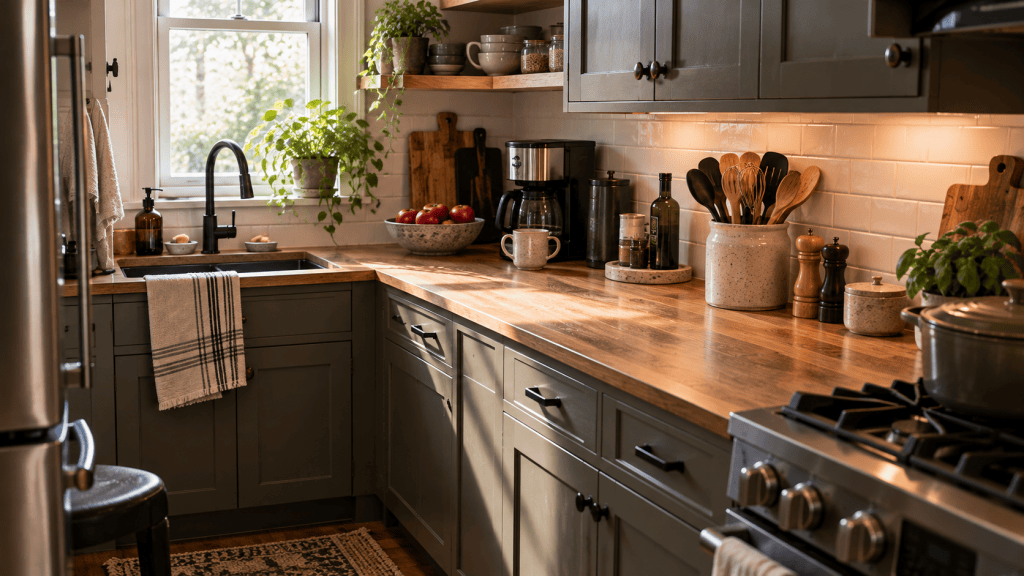
Your kitchen counter has a strange way of collecting permanent residents.
The coffee maker moves in first. Fair enough.
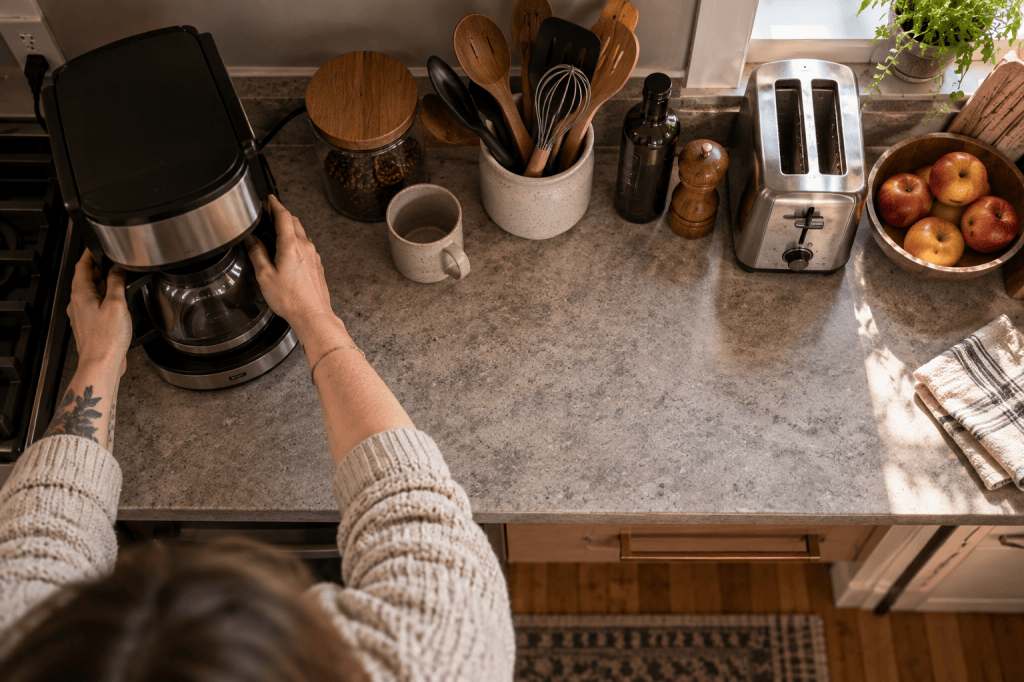
Then the toaster claims a corner. A utensil crock settles beside the stove. Cooking oil stays out because you use it often. The fruit bowl needs somewhere to go. The paper towels land beside the sink.
None of these things seems unreasonable.
But eventually you bring home groceries and have nowhere to put the bags.
Or you start making dinner and have to move three things before the cutting board can come out.
The problem isn’t necessarily that your kitchen is disorganized.
It’s that the counter has quietly become storage.
And in a small kitchen, that’s expensive.
Your kitchen counter already has a job
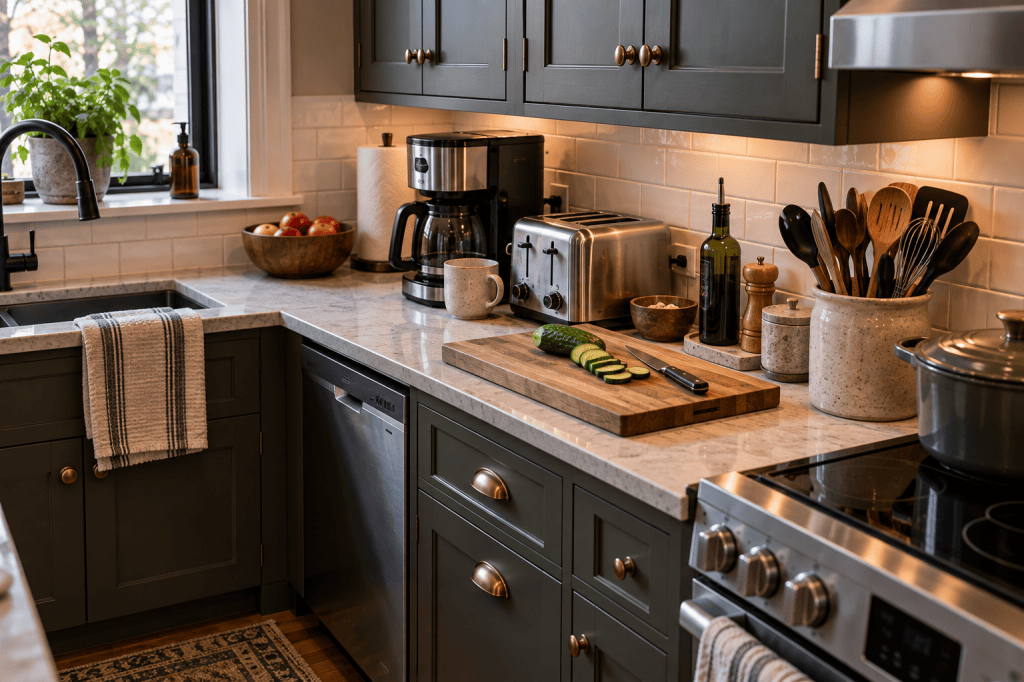
A clear section of counter can look like unused space.
It isn’t.
It’s where you chop vegetables, unpack groceries, make lunches, set down ingredients, plate dinner, unload dishes and put the hot pan you suddenly need somewhere to put.
In other words, clear counter is functional capacity.
That’s why organizing a small kitchen counter isn’t simply a matter of arranging everything more neatly.
You can line up the toaster, coffee maker, knife block, utensil crock and fruit bowl beautifully and still have nowhere comfortable to make a sandwich.
The counter looks organized.
It just isn’t available.
That distinction matters.
Worth the Space has a simple rule for limited spaces:
If something takes up limited space, it should earn its place.
Your kitchen counter is a particularly good place to apply it.
Use the Footprint Test on anything that lives on the counter
The goal isn’t to strip the kitchen bare.
It’s to stop treating permanent counter space as free.
For anything that lives there, ask:
- How often do I actually use this?
- How much working space does it consume?
- Does it benefit from being immediately accessible?
- Is this the best place for it?
- Does keeping it here make another kitchen task harder?
- Would I rather have this object here or have the working space back?
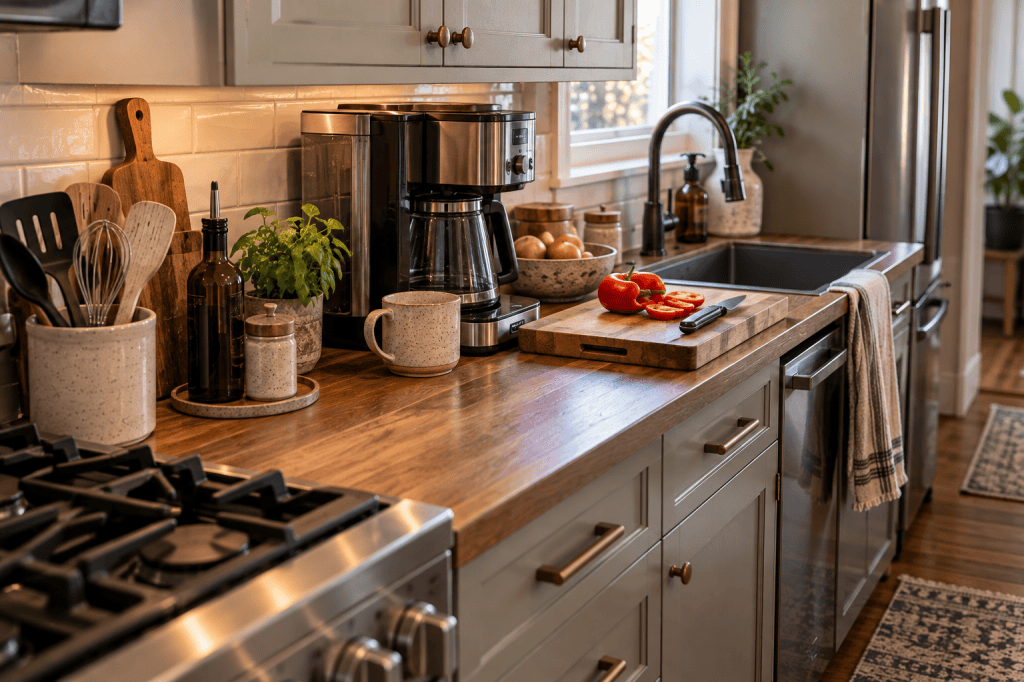
That’s the Footprint Test.
There isn’t a universal passing score.
A coffee maker used every morning might easily earn permanent space in one kitchen.
In another household, coffee happens twice a month and the machine is occupying the best section of counter for no particularly good reason.
The object isn’t the problem.
The relationship between its footprint and its usefulness is what matters.
Frequency matters, but it isn’t the only thing that matters
“Only keep things you use every day” sounds wonderfully decisive.
Real kitchens are a little more annoying than that.
Imagine an appliance you use four times a week. It lives in a lower cabinet. It’s heavy, awkward to retrieve and has to be carried across the kitchen every time you use it.
That appliance might earn counter space even though it isn’t used daily.
Now imagine six small things you use every morning.
Individually, each one has a convincing argument for staying out. Together, they occupy the only useful stretch of counter beside the sink.
Frequency matters.
So do convenience, size, weight, where the item is used, how easily it can be stored elsewhere and what the counter loses by keeping it there.
That’s why this isn’t really a decluttering exercise.
It’s a space-allocation decision.
What actually earns permanent counter space?
There is no Worth the Space approved list of objects allowed on a kitchen counter.
Your kitchen has to support your routines, not ours.
But certain types of things have a stronger case than others.
The appliance you genuinely use
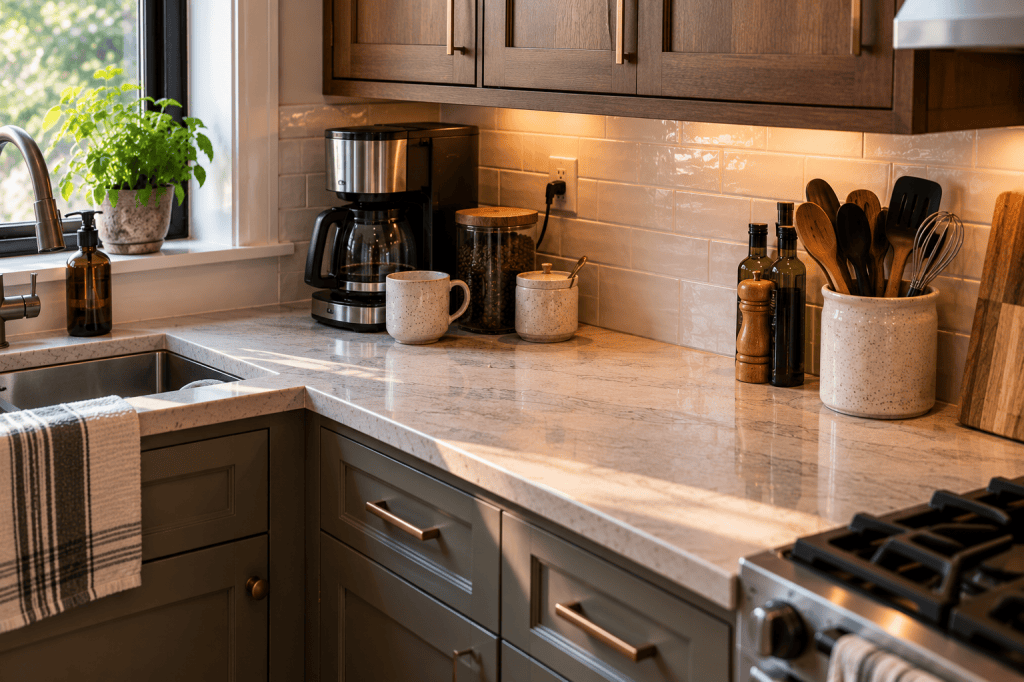
If the coffee maker runs every morning, keeping it accessible probably makes sense.
The same could be true of a toaster, kettle or another appliance your household relies on constantly.
The question isn’t whether an appliance belongs on counters in general.
It’s whether this appliance earns this piece of your counter.
Consider its entire footprint too.
The machine itself takes space, but using it may require additional room around or in front of it. Cords need somewhere sensible to go. Parts may need to open, lift or be removed.
An appliance doesn’t stop consuming space at the edge of its base.
A daily-use zone that makes a routine easier
Sometimes several objects work better as one small functional zone.
Coffee is an obvious example.
If coffee happens every morning, keeping the machine and the few things needed to use it together can make more sense than storing each item separately.
The important word is few.
A useful coffee zone can gradually become coffee beans, tea, syrups, mugs, sweeteners, supplements, travel cups, a decorative sign and seventeen pods nobody particularly likes.
At some point the routine stopped getting easier and the counter started becoming a pantry.
Give the activity the space it needs.
It doesn’t automatically get everything associated with that activity.
Cooking tools that genuinely benefit from immediate access
Some tools make sense near the place they’re used.
If you reach for the same spatula, spoon or cooking oil constantly, immediate access may be more useful than recovering the small amount of space it occupies.
But proximity doesn’t necessarily mean countertop.
A nearby drawer, cabinet, wall or other appropriate storage location may provide the same access while protecting the work surface.
If something genuinely needs to stay accessible, moving it off the working surface may make more sense than eliminating it.
That’s an important distinction for a small kitchen.
Things that are actively being used
Not everything on a counter needs a permanent home somewhere else.
A dish rack might be there because dishes are drying.
Groceries might be waiting to be put away.
Lunch containers might be out because tomorrow’s lunches are being made.
Temporary use is part of the counter’s job.
The problem is when temporary becomes permanent without anyone making the decision.
Kitchen counters are very good at turning “I’ll deal with this later” into a long-term tenancy agreement.
Clear working space
This one deserves to be treated like an item on the list.
Clear counter earns counter space.
You don’t have to justify an open section by finding something to put there.
It is available for whatever the kitchen needs next.
That flexibility is especially valuable when the total surface is small.
What probably doesn’t need to live there?
This is where the Footprint Test becomes useful because the answer isn’t simply “clutter.”
Plenty of perfectly useful things make poor permanent counter residents.
Occasional appliances
A blender used occasionally can still be worth owning.
That doesn’t automatically make the counter its best home.
Look at appliances individually.
How often do you use this one? How awkward is it to retrieve? Is there realistic storage elsewhere? What would you gain by moving it?
An appliance you love doesn’t have to be on display to justify owning it.
Duplicates
Small kitchens make duplication expensive.
Three containers of cooking utensils might each contain useful tools while collectively consuming far more counter than the frequently used tools require.
The same can happen with cutting boards, knife storage, spice containers and beverage supplies.
You don’t necessarily need fewer belongings.
You may need fewer of them permanently occupying the working surface.
Decor that inherited useful space
There is nothing wrong with wanting your kitchen to look good.
Worth the Space is not coming for your fruit bowl.
But decorative objects still have footprints.
If something makes you happy and you willingly give it the space, that’s a legitimate choice.
Just make the tradeoff visible.
On a generous counter, a decorative object might cost almost nothing functionally.
On a tiny counter, the same object could occupy the exact spot where you need to prepare dinner.
Same object. Different cost.
Things that aren’t doing kitchen work at all
Mail.
Receipts.
Chargers.
Keys.
School paperwork.
Packages that need to be returned.
The mysterious object somebody put down “for a second” four days ago.
These things often land on kitchen counters because counters are convenient, visible and horizontal.
That doesn’t make the kitchen their best home.
If the same non-kitchen category repeatedly appears there, don’t just keep moving it.
Ask what home it is missing.
The counter may be revealing a storage problem somewhere else in the house.
Try a small-kitchen counter reset before buying an organizer
You don’t need to reorganize the entire kitchen.
Start with the counter.
Remove the things that don’t physically need to remain there while you make the decisions.
Then look at the clear surface before putting anything back.
This matters because it lets you see what you’re actually allocating.
Instead of asking, “Where can I squeeze this?” you’re deciding whether it deserves to return at all.
Work through the items in four loose groups.
Daily or high-friction to store
These are the strongest candidates for permanent counter space.
They’re used constantly, or storing and retrieving them would create enough inconvenience to outweigh the space you recover.
Put them back deliberately.
Don’t automatically return them to the exact place they were before.
Consider where they’re actually used and what other tasks happen nearby.
Frequent
You use these regularly, but they don’t necessarily need to remain visible all the time.
Look for convenient nearby storage first.
A frequently used item in an easy-to-reach cabinet can be more practical than the same item permanently consuming your prep area.
Occasional
These things are useful enough to keep but don’t need premium access.
This is where less convenient cabinets, pantry storage or another appropriate storage area can start earning their keep.
The goal isn’t to make occasional items irritating to retrieve.
It’s to stop giving occasional activities the kitchen’s most useful real estate.
Not kitchen work
These items don’t need a better countertop organizer.
They need a destination.
If paperwork always lands in the kitchen, create a realistic place for paperwork.
If charging cables migrate there because that’s where the outlet is, decide whether charging belongs there and, if it does, how much space you’re willing to give it.
If random household objects continually appear, look at where they are supposed to go and why they aren’t making it there.
Moving the pile today helps.
Fixing the reason it keeps returning helps more.
Protect one useful section of counter
After the reset, choose the working surface you most need to protect.
It might be where you normally chop and prepare food.
It might be the section where groceries naturally land when you walk in.
It might need to serve several jobs depending on the time of day.
You don’t need to create a complicated system of labelled zones.
You just need to recognize that this section has a job.
When something starts living there permanently, it should have to beat the value of leaving that surface available.
That’s a much higher bar than “there was room for it.”
Be careful with organizers that organize the counter by occupying more counter
This is where small-kitchen organization can get slightly ridiculous.
The counter feels crowded, so you buy an organizer.
The organizer successfully organizes six objects.
It also permanently occupies another chunk of the counter.
Sometimes that’s a good trade.
Sometimes you’ve organized the problem without solving it.
Before buying countertop storage, ask what happens to the working surface afterward.
Does the organizer reduce the total footprint?
Does it make necessary things easier to access?
Does it move objects vertically while preserving useful surface below?
Does it consolidate a messy collection into a genuinely smaller area?
Or does it simply make the same amount of stuff look tidier?
Looking tidier has value.
It just isn’t the same thing as creating more usable counter space.
When buying something actually does make sense
Sometimes the counter reset reveals a genuine storage problem.
You use the items regularly. They need to remain accessible. Your cabinets are already doing useful work. The counter still can’t comfortably support both storage and food preparation.
Now a product may be the right answer.
But the job of that product is clearer.
It needs to create, protect or recover more useful space than it consumes.
That might eventually mean using an appropriate wall, cabinet, under-cabinet area or another existing surface to relocate things that need convenient access.
It might mean replacing a bulky storage method with one that uses the available space more efficiently.
It might mean improving storage inside a cabinet so something no longer needs to live outside it.
And occasionally, adding another surface really may be the answer.
The Worth the Space question remains the same:
What useful space does this give back?
Affiliate disclosure: Worth the Space may earn a commission from qualifying purchases made through affiliate links, at no additional cost to you.
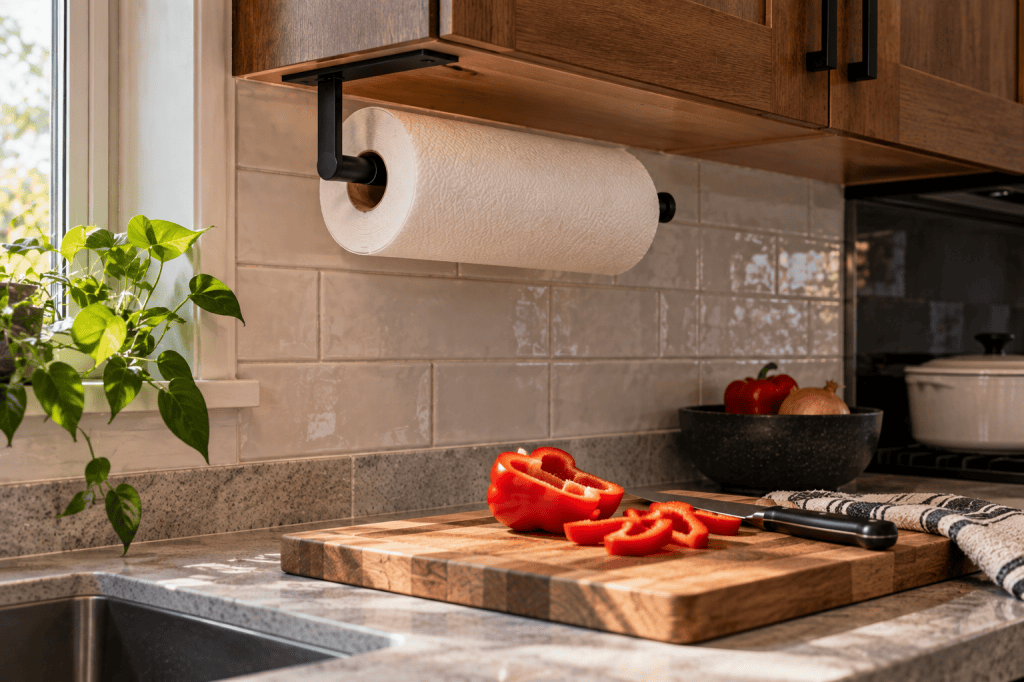
One simple example: An under-cabinet paper towel holder moves something you already use into otherwise-unused space instead of giving it permanent countertop real estate. This DEKAVA holder is designed to mount under a cabinet or on a wall, keeping paper towels accessible while freeing the counter below.
See the DEKAVA under-cabinet paper towel holder on Amazon →
If a storage product takes up more valuable room than the problem it solves, it hasn’t earned its place either.
Your counter doesn’t have to look empty
A functional small kitchen can still have a coffee maker, a bowl of fruit, cooking tools or whatever else supports the people who actually use it.
This isn’t about creating a showroom.
It’s about making sure the kitchen still has room to be a kitchen.
Keep the things that earn immediate access.
Move the things that don’t.
Question anything that permanently occupies useful surface without providing enough value in return.
And protect some counter simply because you need somewhere to work.
Clear counter isn’t empty space.
It’s space that’s available to do its job.


Leave a Reply